How Fast Is a 10 Minute Mile on Treadmill? Your Complete MPH Guide
Have you ever stood in front of a treadmill and wondered what speed you actually need to hit to run a 10-minute mile? You’re definitely not alone. Whether you’re training for a race, trying to improve your fitness level, or just curious about treadmill speeds, understanding the relationship between pace and mph can be surprisingly confusing. Let me break this down for you in a way that actually makes sense.
What Exactly Is a 10-Minute Mile?
Let’s start with the basics. A 10-minute mile simply means covering one mile in 10 minutes. Think of it like driving a certain distance in a specific timeframe. If you need to reach a destination that’s 10 miles away and you have 100 minutes to get there, you’re going at a 10-minute-per-mile pace. Running works the same way, just on foot instead of in a car.
Now here’s where it gets interesting. Most treadmills don’t display your pace in minutes-per-mile format. Instead, they show your speed in miles-per-hour, or mph. This is where many runners get tripped up. The conversion between these two measurements isn’t always intuitive, especially when you’re breathing hard and trying to focus on your form.
The Speed Breakdown: Miles Per Hour Explained
Your treadmill’s mph setting is basically telling you how many miles you’d cover if you maintained that speed for a full hour. So if you’re running at 6 mph, you’d theoretically cover 6 miles in 60 minutes. This is actually the key to our calculation.
The Answer: What MPH Is a 10-Minute Mile?
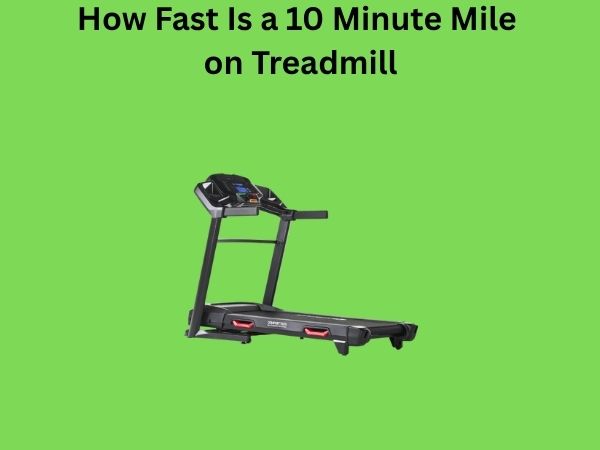
Here’s the straightforward answer you came here for: a 10-minute mile equals 6.0 mph on your treadmill.
Let me show you why this works. If you’re running at 6 miles per hour, you’re covering 6 miles in 60 minutes. Divide that down and you get 1 mile in 10 minutes. It’s that simple. When you set your treadmill to 6.0 mph, you’re running at a 10-minute-mile pace.
But here’s something important to know: this is just one anchor point. Understanding how to work backwards and forwards from this number will help you calculate any pace you want.
How to Calculate Any Treadmill Speed to Pace Conversion
Want to find out what pace corresponds to any mph setting? Or maybe you know what pace you want to run and need to find the mph? I’ll teach you the formula that makes this dead simple.
The Simple Formula Everyone Should Know
The basic formula is this: 60 divided by mph equals your pace in minutes per mile.
Let’s test it with our 10-minute mile example:
- 60 divided by 6 mph equals 10 minutes per mile
- This confirms our answer is correct
Now let’s use it for other speeds to show you how this works:
- 60 divided by 5 mph equals 12 minutes per mile (that’s a slower, more recovery-focused pace)
- 60 divided by 7 mph equals 8.57 minutes per mile (that’s faster and more challenging)
- 60 divided by 8 mph equals 7.5 minutes per mile (that’s approaching competitive running speeds)
- 60 divided by 9 mph equals 6.67 minutes per mile (that’s quite fast)
You can reverse this too. If you know your desired pace and need to find the mph, just flip it: 60 divided by your desired pace in minutes equals the mph you need.
Practical Examples From Your Own Training
Let’s say you want to run an easy recovery day at a 12-minute-mile pace. You’d calculate 60 divided by 12, which gives you 5.0 mph. Set your treadmill to 5.0 and you’re golden.
Or maybe you’re working on speed work and want to hit an 8-minute-mile pace. That’s 60 divided by 8, which equals 7.5 mph. Now you know exactly where to set your machine.
Setting Your Treadmill to 6.0 MPH: The Practical Side
Knowing the math is one thing. Actually running at 6.0 mph on your treadmill is another beast entirely. Let me walk you through what to expect and how to make it work for you.
Locating the Speed Control on Your Machine
Most modern treadmills have a control panel on the front. You’ll usually see up and down arrow buttons or a touchscreen interface. The speed display typically shows decimal increments like 5.8, 5.9, 6.0, 6.1, and so on. Some machines let you increment by 0.1 mph, while others jump by 0.5 mph intervals.
Start by finding your treadmill’s speed controls and familiarizing yourself with how responsive they are. Some machines take a moment to reach the speed you’ve set, while others respond more immediately.
The Warm-Up Protocol Before Going Full Speed
Never just jump on your treadmill and immediately hit 6.0 mph. Your body isn’t ready for it, and your injury risk shoots way up. Here’s what a smart warm-up looks like:
- Start at 4.0 mph for two minutes to get your blood flowing
- Gradually increase to 5.0 mph for another two minutes
- Bump up to 5.5 mph for one minute
- Then move to your target 6.0 mph for your main workout
This gradual approach prepares your muscles, joints, and cardiovascular system for the work ahead. Think of it like slowly pressing the gas pedal instead of slamming it to the floor.
Why Your Treadmill Feels Different Than Outdoor Running
Here’s something that surprises many runners: running at 6.0 mph on a treadmill often feels easier than running a 10-minute mile outdoors. Why is this?
The Treadmill Belt Does Work For You
When you run outside, you have to push yourself forward with every stride. Your legs have to propel your body weight through space and propel you forward against air resistance. On a treadmill, the belt is doing some of that work for you. You’re essentially pulling yourself backward relative to the belt rather than pushing yourself forward through space.
Most experts estimate that treadmill running is about 1 percent easier than outdoor running for every 1 percent of incline you add. So if you set your treadmill to a 1 percent incline, you’re essentially mimicking the resistance of outdoor running.
Missing Environmental Factors
Outside, you’re dealing with wind resistance, changing terrain, and surface variation. Your body is constantly making micro-adjustments. On a treadmill, everything is predictable and smooth. This consistency makes it feel more manageable, even though you’re technically running at the same pace.
Some runners love this about treadmills. Others find the monotony challenging. Knowing this difference helps you adjust your training accordingly.
Training Strategies to Master the 10-Minute Mile Pace
If you’re not yet able to sustain 6.0 mph for your desired distance, don’t worry. There are proven training strategies that’ll get you there.
The Tempo Run Approach
Tempo runs are workouts where you run at a comfortably hard pace for a sustained period. Start by running at 6.0 mph for just 5 minutes if that’s all you can handle. Do this once or twice a week. Each week, add another minute or two.
Before long, you’ll be comfortably running at 6.0 mph for 20, 30, or even 60 minutes. It’s incremental progress that actually works.
Interval Training for Speed Development
Intervals are another powerful tool. Here’s a sample workout:
- Warm up at 5.0 mph for 3 minutes
- Run hard at 6.0 mph for 1 minute
- Recover at 5.0 mph for 1 minute
- Repeat this 1-minute hard, 1-minute easy cycle 8 to 10 times
- Cool down at 4.5 mph for 2 minutes
This approach trains your body to handle 6.0 mph in shorter bursts, which eventually translates to longer sustained efforts at that pace.
Common Mistakes Runners Make on Treadmills
I’ve seen countless runners sabotage their treadmill training without even realizing it. Let me share the mistakes I see most often.
Holding Onto the Handrails
This is probably the most common mistake. When you grip the handrails, you’re essentially lifting part of your body weight off the belt. This reduces the effort your legs have to produce, which means you’re not actually running at the pace you think you are.
If you need the handrails for balance, that’s fine at the beginning of your warm-up. But once you’re moving, let go. Your core will strengthen, and your workouts will be far more effective.
Looking Down at Your Feet
Many treadmill runners develop a habit of staring down at their feet. This throws off your posture and makes the effort feel harder. Keep your eyes forward and your head in a neutral position, just like you would outdoors.
Running Too Fast Too Soon
Jumping straight to 6.0 mph when you’ve never run that pace before is a recipe for injury and burnout. Build your base gradually. Most training experts recommend increasing your pace by no more than 5 to 10 percent per week.
Ignoring Incline Settings
Remember what I mentioned about treadmill running feeling easier? If you want to replicate outdoor conditions and truly challenge yourself, add that 1 percent incline. Many runners find this small adjustment makes their treadmill training much more valuable.
Tips for Maintaining Consistent 10-Minute Mile Pace
Once you can hit 6.0 mph, keeping it consistent is the next challenge. Here’s how to maintain that pace without letting your mind games sabotage you.
Break Your Run Into Segments
If you need to run for 30 minutes at 6.0 mph, don’t think about the full 30. Think about running 10 minutes at a time. Three 10-minute segments feel much more manageable than one big 30-minute block.
Use Music and Podcasts Strategically
The right music can completely change your treadmill experience. Look for songs with a rhythm that matches your running cadence. A good playlist distracts your mind and makes the time fly by.
Alternatively, many runners love listening to podcasts or audiobooks during treadmill sessions. An engaging story makes the workout feel less like work.
Monitor Your Form Every Few Minutes
As fatigue sets in, your form tends to deteriorate. Your stride shortens, you start leaning forward, and your cadence changes. Every few minutes, do a quick mental body scan. Shoulders relaxed? Arms at 90 degrees? Landing midfoot? These checks help you maintain quality throughout your run.
Progressive Training Methods to Build Endurance
If your goal is to run a 10-minute mile for longer distances, you need a structured approach to build that endurance safely.
The Weekly Training Structure
A solid week of treadmill training might look like this:
- Monday: Easy 30-minute run at 5.5 mph
- Tuesday: Interval training with tempo repeats at 6.0 mph
- Wednesday: Rest day or cross-training
- Thursday: Steady tempo run at 6.0 mph for 15-20 minutes
- Friday: Easy recovery run at 5.0 mph
- Saturday: Long run at comfortable pace, gradually building duration
- Sunday: Rest
This structure gives you variety, adequate recovery, and progressive overload. You’re hitting 6.0 mph multiple times per week in different contexts, which trains your body and mind for this pace.
The Long Run Build
Your long run doesn’t need to be at race pace. In fact, it shouldn’t be. But as you build your weekly mileage and long run distance, occasionally practice your long run at 6.0 mph. Start with 10 minutes and add a minute or two each week until you can sustain it for however long you need.
Equipment Considerations for Optimal Performance
Your shoes, attire, and the treadmill itself all play a role in your ability to run at 6.0 mph comfortably and safely.
Finding the Right Running Shoes
The wrong shoes can make running at 6.0 mph feel impossibly hard. Visit a specialty running store where they can analyze your gait. Do you overpronate, underpronate, or have a neutral stride? This determines which shoes will support you best on the treadmill.
The right shoes reduce injury risk and make the pace feel more sustainable. It’s worth the investment.
Choosing Your Clothing
On a treadmill, you don’t have wind to cool you down, so you’ll heat up faster than you would outside. Choose moisture-wicking fabrics that pull sweat away from your skin. Avoid cotton, which absorbs moisture and becomes heavy.
Treadmill Quality Matters
A cheap, worn-out treadmill with a thin belt is harder on your joints and less responsive to your efforts. If you’re training seriously, invest in a decent machine. The cushioning, belt quality, and motor responsiveness all affect your running experience.
The Mental Game of Treadmill Running
Here’s something many people overlook: treadmill running is as much mental as it is physical. Running at 6.0 mph on a treadmill requires mental tough